


Accreditation is an essential process that confirms medical laboratories’ compliance with ISO 15189 standards. In Africa, accredited medical laboratories gain numerous advantages, including improved accuracy and speed of diagnostic services, more efficient treatment, and fewer errors throughout laboratory workflows. Overall, this process enhances laboratory quality across the region, enabling stronger support for disease management, prevention, control, and epidemic response.
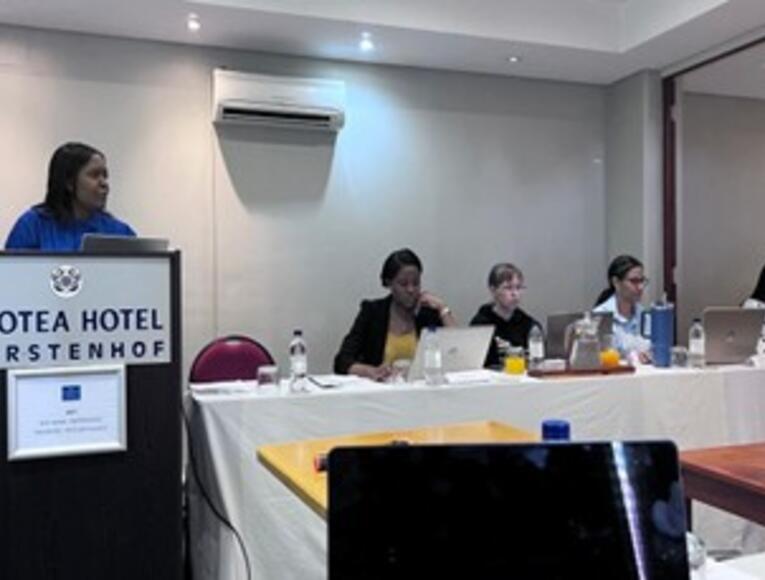
Through the Assessor Capacity Development Programme, the Southern African Development Community Accreditation Service (SADCAS) conducted an Assessor training course for 18 Experts from government and private Medical Laboratories in Namibia. The training was funded by the SADCAS through the assessor training, mentoring and monitoring budget.
The SADCAS Assessor Development Programme implemented across member countries effectively reduces travel-related accreditation costs by:
- Training local assessors.
- Minimizing cross-border travel.
- Building national capacity and expertise.
- Increasing accessibility and affordability of accreditation.
- Supporting regional industrialization and trade goals. By developing assessors where the clients are located, SADCAS creates a cost-efficient, sustainable, and regionally harmonized accreditation service.
The training was conducted from 27-31 October 2025 at Protea Hotel Windhoek Fürstenhof Namibia by Mrs Eva Muronda, a registered SADCAS Technical Assessor/Team Leader and Scheme Coordinator for Medical Laboratory Accreditation Scheme and Ms Mponeng Poo, a registered SADCAS Trainer and Team Leader for Medical Laboratories.
The training was in 2 phases. The first phase was training on ISO 15189:2022 Requirements and Risk management. The second phase focused on assessment techniques and understanding the SADCAS accreditation process.
Training sessions were interwoven with group activities, such as performing assessments using different checklists (including Witnessing and Vertical), writing nonconformities, and taking part in meetings like opening and closing sessions.
For the assessor component of the course, the approach combined group-based practical work with exercises reflecting real scenarios encountered during assessments. Participants received assessment packets to review collaboratively and completed the appropriate checklists. They were also taught how to evaluate the adequacy of a facility’s documentation and then given a hands-on exercise with feedback to assess their comprehension.
All participants passed the written examination and are ready for the next stage of mentoring and monitoring scheduled in 2026. Thereafter the experts will be registered as SADCAS assessors upon successful fulfilment completion of training.